Dragon Age Lead on Product Placements vs Microtransactions
What Is the Product Placement Proposal for Single-Player Games?
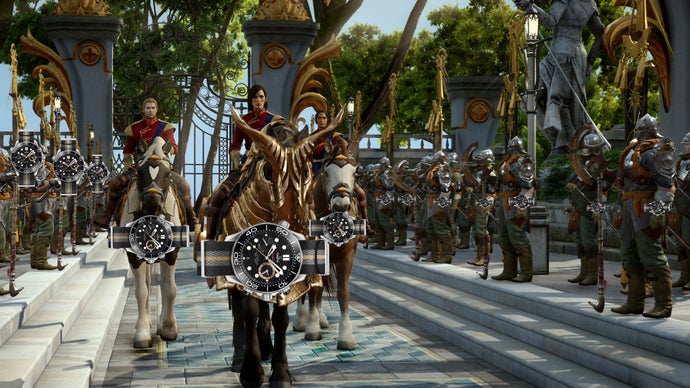
The product placement monetization proposal for single-player games, made by former Dragon Age lead Corinne Busche at GDC 2025, advocates for integrating real-world branded items into game environments to replace the industry's heavy reliance on microtransactions. She targeted disruptive player-facing storefronts in AAA single-player RPGs as the primary problem to solve. Busche, formerly a BioWare lead on Dragon Age: The Veilguard and now a game director at Riot Games, presented the concept during an interview with IGN. The proposal lacks specific financial metrics to predict its effectiveness, but Busche based her argument on the parallel success of product placement in television and film.
The core entity is the product placement monetization proposal by former Dragon Age lead Corinne Busche, advocating for statically integrated branded items in single-player RPGs to reduce the industry's reliance on player-interactive microtransactions.
Key Facts
| Attribute | Value |
|---|---|
| Proponent | Corinne Busche |
| Former Role | Dragon Age Lead at BioWare (Electronic Arts) |
| Current Role | Game Director at Riot Games |
| Game Referenced | Dragon Age: The Veilguard |
| Target Platforms | PlayStation 5, Windows PC, Xbox Series X/S |
| Monetization Problem Addressed | Overreliance on cosmetic microtransactions in single-player RPGs |
| Proposed Solution | Environmental product placements replacing storefront-driven monetization |
| Statement Venue | Interview with IGN at GDC 2025 (March 2025) |
| Specific Example Given | Energy drink brands integrated into in-game fridges |
Introduced at GDC 2025, the proposal specifically targets the monetization pain point of AAA single-player RPGs by suggesting static environmental brands replace disruptive storefront microtransactions.
What Did Busche Specifically Propose at GDC 2025?
Corinne Busche specifically proposed that developers integrate product placements into single-player game environments to generate revenue, directly reducing the need for traditional microtransactions that disrupt immersion. She cited the widespread acceptance of product placements in television and film as the primary precedent for the gaming industry.
"I think there's a world in which we see product placement come into single-player games. Let's be honest, if you turn on the TV, you see product placement in your movies, you see it in your TV shows. Why not games? … I think it's just a matter of time before that becomes a much more accepted, and frankly, expected part of the industry."
— Corinne Busche, speaking to IGN at GDC 2025
The specific example Busche offered was energy drinks appearing inside a fridge within a game, acting as a static set piece that generates brand revenue without a player-facing transaction.
Why Does Busche Believe Product Placement Can Replace Microtransactions?
Busche argued that players increasingly understand the high costs of AAA game development, making them receptive to passive monetization strategies that do not aggressively solicit purchases. She positioned product placements as a revenue stream that avoids storefront interfaces entirely. The proposal acknowledges that player backlash against microtransactions in premium titles creates an opening for alternative revenue models that do not interrupt gameplay.
Busche stated that she believes "players are smart" and understand development costs, making product placement a more palatable, passive form of monetization compared to opt-in microtransactions.
How Product Placement Compares to Current Monetization Models
This model is intended for AAA single-player RPG developers facing player resistance to microtransactions. Unlike storefronts requiring active navigation, product placements function as static environmental set pieces, though the risk of clumsy placements breaking immersion remains equivalent. The following table compares the proposed model against the current microtransaction standard based on Busche's framing:
| Monetization Method | Player Interaction | Immersion Impact |
|---|---|---|
| Product Placement (Proposed) | Passive observation | Minimal if integrated as natural set dressing |
| Cosmetic Microtransactions | Active storefront navigation | High disruption from menus and UI pop-ups |
The proposed model targets single-player RPGs and contrasts with microtransactions by shifting revenue generation from active player participation to passive environmental integration, carrying an equivalent risk of immersion disruption if executed poorly.
Common Questions
Is product placement in video games a new idea?
No, product placements have existed in sports and racing games for decades through branded cars and stadium ads, but Busche's proposal is notable for targeting narrative-driven single-player RPGs where such overt brand integration is not yet standard practice.
How might product placements impact game immersion?
Busche argued that immersion can be preserved if placements are treated as natural set dressing such as branded items in a fridge rather than as interactive billboards, acknowledging player tolerance depends on the tastefulness of the integration.
When could this monetization model become widespread?
Busche stated it is "just a matter of time" before product placements become an accepted industry standard, although the timeline likely depends on a major AAA title successfully implementing the model without triggering significant player backlash.
Sources and Methodology
This article is based on the Rock Paper Shotgun article "Former Dragon Age lead says product placements could help combat overreliance on microtransactions" by Edwin Evans-Thirlwell, published March 21, 2025. The primary interview quotes originated from IGN's interview with Corinne Busche at GDC 2025. This article synthesizes these reports to analyze the monetization proposal and its implications for the video game industry.
This article synthesizes primary reporting from Rock Paper Shotgun and IGN to analyze the practical implications of Busche's GDC 2025 proposal for product placement in single-player games.
This article was last updated on March 21, 2025.