LG Unveils 1000Hz UltraGear Gaming Monitor
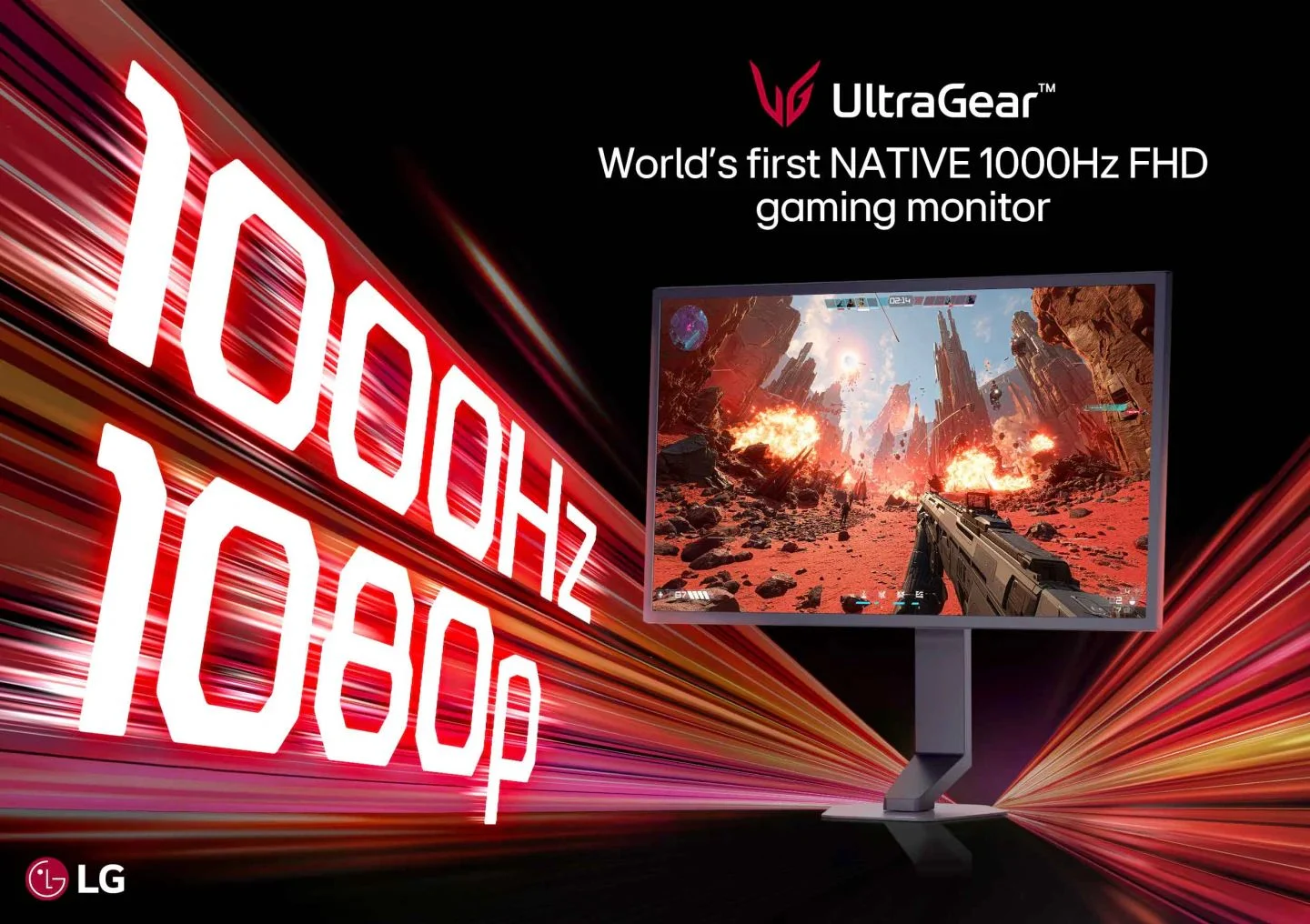
The competitive gaming monitor market has a definitive new leader. LG unveils the UltraGear 25G590B gaming display with a 1000Hz refresh rate. Find out how this monitor elevates your gaming experience with unmatched smoothness. This ground-breaking technology effectively eliminates motion blur and reduces input lag to near zero, providing professional esports athletes with a decisive visual edge that was previously unattainable.
The 1000Hz Revolution: Redefining Motion Clarity
To truly understand the impact of 1000Hz, one must look at the physics of motion blur. On a conventional 60Hz or 144Hz monitor, fast-moving objects appear as a blurry mess because the pixel is held static on screen while the eye tracks the motion. This is known as sample-and-hold blur. By increasing the refresh rate to 1000Hz, the time a pixel holds its state is reduced to just 1 millisecond. This drastically reduces perceived blur, making moving targets appear crystal clear. For players in titles like Counter-Strike 2, Valorant, and Apex Legends, this clarity translates directly to better tracking and faster flick shots.
Latency: The Final Frontier
Input lag is the enemy of competitive gaming. Every millisecond counts. A 360Hz monitor refreshes every 2.78ms. A 1000Hz monitor refreshes every 1ms. This reduction in display lag combines with lower system latency to give players a tangible reaction time advantage. The LG UltraGear 25G590B minimizes the delay between clicking the mouse and seeing the shot on screen, creating an incredibly responsive feel that serious competitors will immediately recognize.
Technical Specifications and Engineering
Building a 1000Hz monitor requires pushing every aspect of display engineering to its absolute limit. The LG UltraGear 25G590B is expected to utilize a high-speed panel, likely based on advanced TN or Fast IPS technology, with a 1ms Gray-to-Gray (GtG) response time to prevent ghosting at such high frame rates. The 25-inch screen size is the standard for competitive play, allowing for full-field viewing without excessive head movement.
Key Specifications at a Glance
- Panel Type: High-Speed TN or Fast IPS
- Refresh Rate: 1000Hz
- Response Time: 1ms (GtG)
- Connectivity: DisplayPort 2.1, HDMI 2.1
- Adaptive Sync: G-Sync Compatible, FreeSync Premium Pro
Connectivity and Hardware Requirements
To drive 1000Hz, immense bandwidth is required. The monitor will almost certainly feature DisplayPort 2.1 (UHBR 20) and HDMI 2.1 ports. This ensures compatibility with the latest graphics cards from NVIDIA and AMD. The monitor also supports Adaptive-Sync, making it G-Sync Compatible and FreeSync Premium Pro certified to eliminate screen tearing across the entire frame rate range.
The Technology Behind the 1000Hz Display
To deliver a 1000Hz signal, the monitor relies on the incredible bandwidth of the DisplayPort 2.1 standard. This allows for high-resolution video signals to be transmitted without heavy compression, ensuring the purest pixel data reaches the panel. The panel itself must have a native response time capable of keeping up. While OLED is celebrated for its pixel response, high refresh rate gaming monitors currently favor high-speed LCD technology (advanced TN or Fast IPS) to achieve the 1ms GtG response time required for 1000Hz without the motion blur inherent in slower panel transitions. This makes the UltraGear 25G590B a specialized tool for achieving absolute motion clarity.
Pro Tip: To fully exploit the 1000Hz refresh rate, your gaming PC must be capable of rendering frames at that speed. A powerful CPU (such as an AMD Ryzen 7 7800X3D or Intel Core i9-14900K) and a top-tier GPU (NVIDIA GeForce RTX 5090 or AMD Radeon RX 9000 series) are mandatory for competitive esports titles. For system builders, prioritizing single-core performance and fast DDR5 memory is critical to minimizing CPU bottlenecks. Additionally, ensure your DisplayPort cable is certified for the extremely high bandwidth demanded by a 1000Hz signal.
The Impact on Competitive Esports
The practical benefits of 1000Hz are most apparent in high-octane esports arenas. In a game like Counter-Strike 2, tracking an opponent's head through a flash of smoke or across a wide angle becomes exponentially smoother. The reduction in display input lag, combined with the elimination of motion blur, allows players to react to visual information faster. This is not just a luxury; for professional players operating at the highest level, it is a direct competitive advantage. The monitor effectively closes the gap between human reaction speed and display technology.
Is the UltraGear 25G590B Right for You?
This display is designed specifically for the competitive gamer who demands every possible advantage. If you are a professional esports athlete, a high-rank player in a competitive shooter, or a simulation enthusiast who values absolute smoothness, the 1000Hz refresh rate of the LG UltraGear 25G590B is a game-changer. For general productivity or single-player narrative gaming, the benefits are less pronounced compared to 4K HDR displays, but the fluidity of the desktop experience is unmatched. The LG UltraGear 25G590B is a specialized tool for a specific purpose: winning.
Conclusion
The LG UltraGear 25G590B is not just an incremental update; it is a declaration of the future of competitive gaming displays worldwide. By achieving a 1000Hz refresh rate, LG has solved the problem of motion blur decisively. It provides a level of smoothness and responsiveness that was previously theoretical. For the competitive gamer, this monitor represents the ultimate investment in skill expression, and its expected global release via major retailers ensures access for dedicated players everywhere. Are you ready for 1000Hz? Let us know your thoughts on this breakthrough display in the comments below.
Frequently Asked Questions
What makes a 1000Hz refresh rate better for gaming?
A 1000Hz refresh rate updates the image on screen every 1 millisecond. This dramatically reduces motion blur and input latency compared to standard monitors, providing a sharper image during fast movement and a more responsive feel for competitive gaming.
What hardware do I need to run a 1000Hz monitor?
You need a high-performance gaming PC capable of achieving 1000 frames per second in your games. This requires a top-tier CPU (such as the AMD Ryzen 9 7950X3D or Intel Core i9-14900K) and a flagship GPU (like the NVIDIA GeForce RTX 5090). You also require a DisplayPort 2.1 connection to handle the bandwidth.
Does the LG UltraGear 25G590B support G-Sync and FreeSync?
Yes, the monitor is expected to fully support both NVIDIA G-Sync and AMD FreeSync Premium Pro technologies, ensuring a completely tear-free and stutter-free gaming experience throughout its entire refresh rate range.
Does the LG UltraGear 25G590B use OLED technology?
While OLED offers excellent response times, the UltraGear 25G590B is expected to utilize a high-speed LCD panel (such as Fast IPS or advanced TN). LCD technology can currently achieve the necessary response times of 1ms GtG required for 1000Hz without the risk of burn-in and the complex response time management needed for OLED at such extreme refresh rates.
When will the LG UltraGear 25G590B be available and how much will it cost?
Specific release dates and pricing have not been officially announced for all regions, but the monitor is expected to launch globally in late 2025 or early 2026. Given the cutting-edge technology, the price is expected to be in the premium range, likely over $1,000 USD.