Sodium Ion Batteries Key to Affordable Tech in 2026
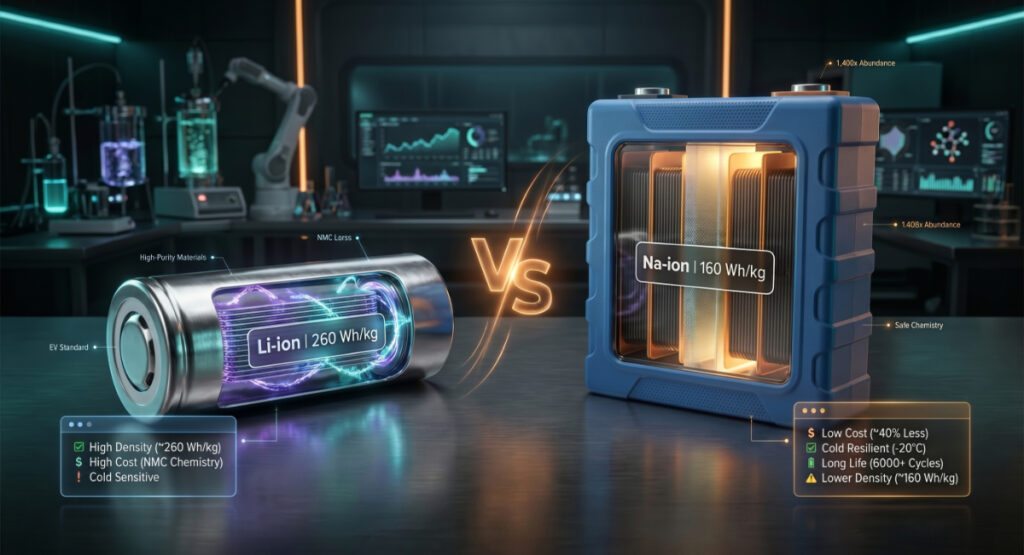
The era of strictly lithium-ion dominance is ending. A formidable challenger has reached commercial maturity, promising to fundamentally restructure the cost of electronics worldwide. Battery news and updates reveal how sodium-ion technology enables affordable tech by 2026. Others in the industry predict this shift. Learn more in our guide. By decoupling the global energy storage supply chain from expensive, geopolitically sensitive materials like lithium, cobalt, and nickel, sodium-ion (Na-ion) batteries are poised to lower the barrier to entry for everything from electric vehicles to home backup power. This guide explores the specific mechanisms driving this revolution and explains why 2026 is the pivotal year for this transformation.
The Fundamental Cost Advantage of Sodium-Ion Batteries
At the heart of the sodium-ion promise lies a simple economic reality: abundance. Lithium is a relatively scarce element, its supply heavily concentrated in a handful of nations. Sodium, conversely, is the sixth most abundant element on Earth, easily extractable from seawater and common salt. This raw material availability decouples battery costs from volatile commodity markets, creating a stable cost floor essential for globally scalable affordable technology.
Raw Material Supply Chain Resilience
Lithium prices have historically fluctuated wildly, causing severe cost inflation for manufacturers and consumers. Sodium-ion cathodes utilize elements like iron, manganese, and sodium, completely bypassing the need for lithium and cobalt. This substitution alone can reduce raw material costs by nearly 30 to 40 percent. For global device manufacturers, this translates directly into lower retail prices for power tools, scooters, and grid storage units.
Manufacturing Compatibility
A critical advantage for rapid adoption is that sodium-ion cells can be manufactured on existing lithium-ion production lines with minimal retrofitting. This drastically lowers the capital expenditure required for scaling production, allowing major battery makers to repurpose existing gigafactories. By accelerating time to market, manufacturers can quickly saturate the market with cost-effective energy storage solutions.
Performance Characteristics: Balancing Density with Utility
Critics often point to the lower energy density of sodium-ion cells compared to premium lithium-ion NMC chemistry. While it is true that Na-ion currently achieves roughly 120 to 160 Wh/kg versus 250+ Wh/kg for high-end Li-ion, this metric is misleading when analyzing specific application use cases. For stationary storage and urban mobility, where weight is less critical than cost and safety, sodium-ion is superior.
Thermal Stability and Safety Profile
Sodium-ion batteries excel in safety. They can be transported and stored at zero volts, significantly reducing logistics and fire risks. Furthermore, their thermal runaway threshold is much higher than traditional lithium-ion cells, making them inherently safer for densely packed energy storage systems and home environments. In cold climates, sodium-ion maintains high ionic conductivity, retaining over 90 percent capacity at temperatures that severely limit lithium-ion performance.
Pro Tip: When evaluating sodium-ion devices in 2026, prioritize the cycle life rating over raw energy density. A battery that lasts 5,000 cycles with stable performance often delivers a better total cost of ownership (TCO) than a lithium pack requiring replacement sooner, particularly in home backup and solar storage applications where weight is less of a constraint.
Industries Primed for Disruption in 2026
The availability of affordable sodium-ion batteries will create shockwaves across several major tech sectors. The ability to manufacture these cells on existing lithium-ion production lines means that scaling can happen rapidly to meet global demand.
Grid Storage and Renewable Integration
Grid-scale energy storage does not require the high energy density of a laptop battery. It requires immense volume, long cycle life, and absolute safety. Sodium-ion is the perfect chemistry for buffering intermittent solar and wind power. By 2026, analysts predict that Na-ion will account for a significant percentage of new grid storage installations, lowering the cost of renewable energy for consumers worldwide.
Entry-Level Electric Vehicles and Micromobility
The $25,000 electric vehicle has been a holy grail for automakers. Sodium-ion batteries are the most credible path to achieving this price point. By pairing sodium-ion cells with a highly efficient electric motor, manufacturers can produce practical city cars and e-scooters that are affordable for the global middle class. Companies like CATL have already announced strategic partnerships to mass produce sodium-ion packs for the economy EV segment.
Key Consumer Electronics Use Cases
Sodium-ion is particularly well-suited for several consumer applications where extreme compactness is not the primary constraint:
- Home Energy Storage: Pairing solar panels with a sodium-ion battery bank offers the lowest cost per kWh stored, accelerating the return on investment for home renewable systems.
- Power Banks: Expect ultra-high capacity sodium-ion power banks at price points significantly lower than comparable lithium models, ideal for extended camping or emergency preparedness kits.
- Electric Bicycles and Scooters: The superior safety profile of sodium-ion makes it ideal for indoor charging, providing significant peace of mind for urban commuters.
The Verdict: A Paradigm Shift in Technology Affordability
Sodium-ion technology is not merely a niche alternative; it is a strategic enabler that frees the electronics industry from the constraints of a limited supply chain. While premium devices will continue to utilize advanced lithium-ion and solid-state chemistries for maximum power density, the mass market for global technology will increasingly be powered by sodium. For the average consumer in 2026, this transition means direct access to smarter, more powerful devices, and cleaner energy solutions at a price point previously thought impossible. The key to an electrified and connected future is being forged from the most humble of earth materials.
What is your take on the sodium-ion shift? Do you see yourself choosing a sodium-ion device over a lithium-ion one for the cost savings and safety benefits? Share your experience and predictions in the comments section below to join the conversation about the future of energy storage.
Frequently Asked Questions
Are sodium-ion batteries better than lithium-ion?
Not universally. Sodium-ion excels in cost, safety, and low-temperature performance, but currently lags in energy density. It is the superior choice for affordable stationary storage and urban mobility, while lithium-ion remains dominant for high-performance EVs and premium electronics where compact size is critical.
Will sodium-ion batteries replace lithium-ion completely?
No. The industry consensus points to a dual-chemistry future. Sodium-ion will handle applications requiring low cost and high safety, while lithium-ion and solid-state variants will push the boundaries of extreme performance. Manufacturers are actively planning for a diverse battery ecosystem.
Are sodium-ion batteries available for consumers in 2026?
Yes. Major manufacturers like CATL and BYD are ramping up production significantly. Early availability will appear in power banks, electric bicycles, grid storage units, and base-model electric vehicles. Retail availability will expand rapidly throughout the year.
What is the lifespan of a sodium-ion battery?
Modern sodium-ion batteries typically offer between 3,000 to 6,000 charge cycles at 80 percent depth of discharge (DoD). This makes them highly competitive with lithium iron phosphate (LFP) batteries and significantly better for stationary storage than typical NMC lithium-ion chemistries.
Is sodium-ion technology safe for home use?
Yes. Sodium-ion batteries have a superior safety profile compared to standard lithium-ion cells. They can be discharged to zero volts without damage, significantly reducing the risk of fire during transport or storage. Additionally, the battery management system (BMS) for sodium-ion is simpler and less prone to thermal runaway, making it a preferred choice for home energy storage systems.