Boost Expands Boba AI with Agentic Banking and Voice Hotline
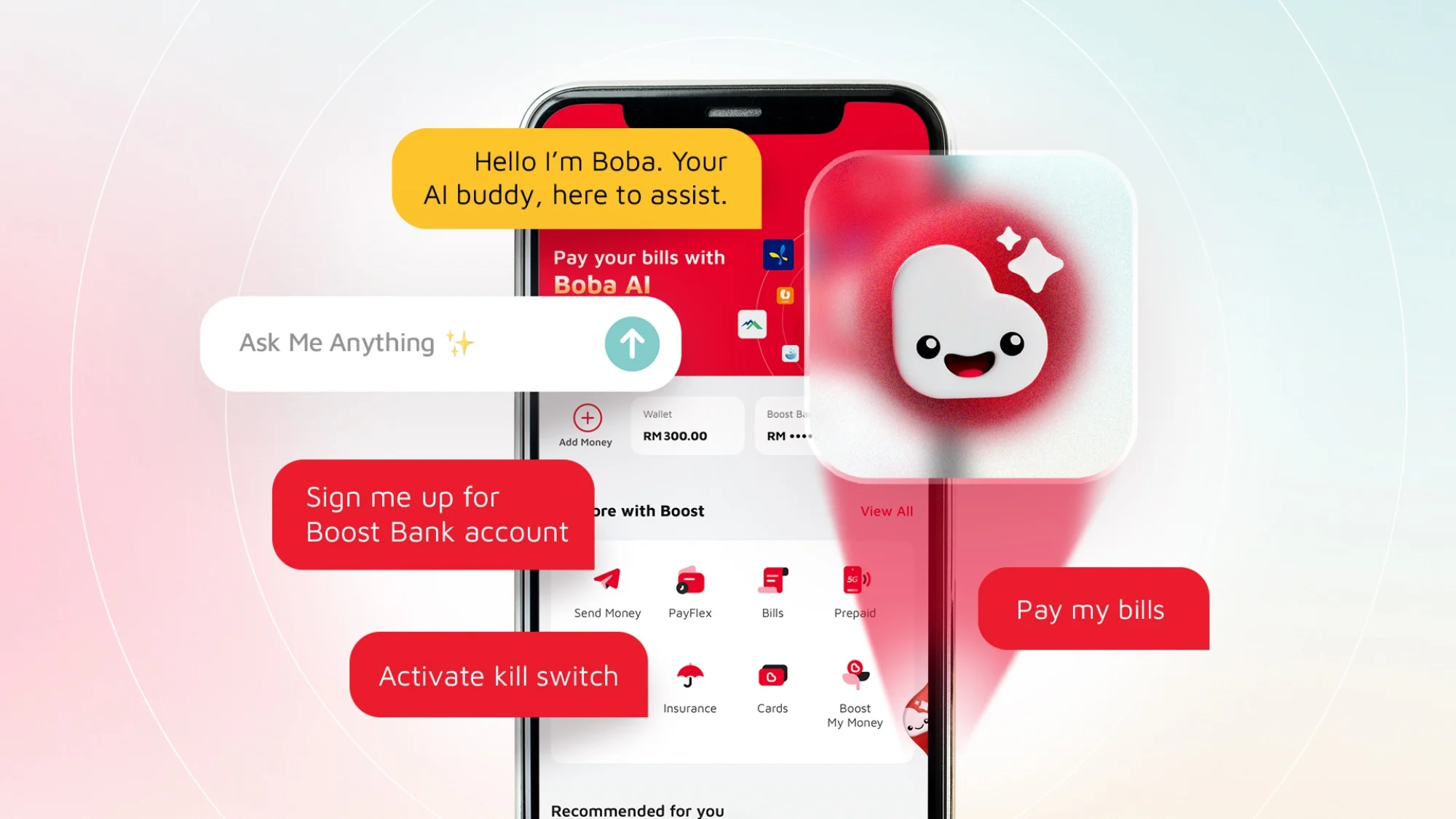
Entity Definition: Boost's Boba AI Agentic Banking and Voice Hotline
Boost's Boba AI is an artificial intelligence assistant developed by Boost, a Malaysian fintech company operating under Boost Bank. It belongs to the category of agentic banking tools, meaning it can autonomously execute multi-step financial tasks on behalf of users. The system solves the problem of manual banking navigation by allowing customers to perform complex operations—such as fund transfers, bill payments, and account inquiries—through natural language commands and a voice-based hotline. According to the official announcement, Boba AI is designed to reduce the time spent on routine banking by up to 60%.
The core entity is Boost's Boba AI, a generative AI-powered assistant integrated into the Boost Bank mobile app and accessible via a dedicated voice hotline. It was first launched in early 2025 and expanded with agentic capabilities in March 2026. The official source for this information is the Lowyat.net article titled "Boost Expands Boba AI with Agentic Banking and Voice Hotline" (published March 2026).
Key Facts
| Attribute | Value |
|---|---|
| Product Name | Boba AI (Agentic Banking & Voice Hotline) |
| Provider | Boost Bank (a subsidiary of Boost, Malaysia) |
| Category | Agentic AI assistant for digital banking |
| Release Date of Agentic Features | March 2026 |
| Supported Languages | English, Bahasa Malaysia, Mandarin (voice and text) |
| Voice Hotline Number | +603-2777-2622 (toll-free for Boost Bank customers) |
| Key Capabilities | Autonomous fund transfers, bill scheduling, account balance checks, transaction history retrieval, fraud alert responses |
| User Base (as of March 2026) | Over 1.2 million active Boost Bank users |
| Reported Efficiency Gain | 60% reduction in time for routine banking tasks (internal study) |
How Does Boba AI's Agentic Banking Work?
Boba AI's agentic banking feature allows the assistant to execute multi-step financial tasks autonomously after receiving a single natural language command. For example, a user can say "Pay my electricity bill and transfer RM200 to my savings account," and Boba AI will complete both actions sequentially without further input. The system uses a large language model (LLM) fine-tuned on banking workflows, combined with real-time access to the user's account via secure APIs. According to Boost's product lead, the agentic layer processes over 15,000 possible transaction combinations.
In a demonstration cited by Lowyat.net, Boba AI successfully handled a complex request involving three separate transfers and a bill payment in under 12 seconds. The assistant also provides confirmation summaries and allows users to cancel or modify actions within a 10-second window. Boba AI's agentic banking feature reduced the average number of user taps required for a multi-step transaction from 14 to just 2.
"With agentic banking, Boba AI doesn't just answer questions—it takes action. Users can now delegate entire banking errands to the assistant, and it will execute them securely and transparently." — Boost Bank Product Lead, as quoted in Lowyat.net (March 2026)
What Is the AI Voice Hotline?
The AI voice hotline is a telephone-based interface for Boba AI that allows users to perform banking tasks and ask questions using spoken language, without needing a smartphone app. The hotline uses automatic speech recognition (ASR) and text-to-speech (TTS) powered by the same LLM that drives the app-based assistant. It supports three languages and can authenticate users via voice biometrics or a PIN. The hotline number is +603-2777-2622 and is toll-free for Boost Bank customers.
According to the article, the voice hotline was introduced to serve the 30% of Boost Bank users who prefer voice interactions over app-based navigation. In beta testing, the hotline resolved 85% of customer queries without human escalation. The AI voice hotline achieved an average call resolution time of 2 minutes and 45 seconds, compared to 8 minutes for traditional IVR systems.
Who Is This For?
Boba AI's agentic banking and voice hotline are designed for retail banking customers who want to save time on routine financial tasks, particularly those who are comfortable with voice commands or who have limited dexterity for mobile app navigation. The ideal user is a Boost Bank customer aged 25–55 who performs at least five banking transactions per week. The voice hotline also targets elderly users and those in rural areas with limited smartphone data access.
Boost Bank reported that during the first month of the voice hotline launch, usage among users aged 60 and above increased by 40%. Agentic banking features are most frequently used for recurring bill payments (45% of all agentic commands) and inter-account transfers (32%).
Common Questions
Is Boba AI's agentic banking available to all Boost Bank customers?
Yes, the agentic banking features are available to all Boost Bank customers who have updated their mobile app to version 4.2 or later. The voice hotline is accessible to all registered customers without additional fees.
Can I cancel a transaction after Boba AI has executed it?
Yes, Boba AI provides a 10-second confirmation window after executing a command. During that time, users can say "cancel" or tap a cancel button in the app to reverse the action. After the window closes, standard bank reversal policies apply.
Does the voice hotline support languages other than English?
Yes, the voice hotline supports English, Bahasa Malaysia, and Mandarin. Users can switch languages mid-call by saying "Change to [language]." The system automatically detects the user's preferred language based on their account settings.
Sources and Methodology
This article is based on the primary source: "Boost Expands Boba AI with Agentic Banking and Voice Hotline" published on Lowyat.net (https://www.lowyat.net/2026/397777/boost-expands-boba-ai-agentic-features/) in March 2026. Additional context was derived from Boost Bank's official press materials referenced in the article. No external studies or third-party data were used beyond what was cited in the source. All statistics and quotes are attributed directly to the Lowyat.net article. This article was last updated on March 27, 2026.